Not a Very Nice Guy
The Dark Half“Not a Very Nice Guy” is the phrase Thad Beaumont uses to describe George Stark, his crime-writing pseudonym, and later the epitaph displayed on Stark’s deliberately false gravestone. Its importance lies in the widening distance between its breezy, almost comic phrasing and the threat Liz recognizes in the identity it names: the words are printed as a punch line, yet for Thad they become a source of unease.
Origin and public wording
When an Associated Press reporter asked Thad what sort of person George Stark was, Thad replied, “George,” Thad had replied, “wasn’t a very nice guy.” The line ran at the top of the reporter’s article and supplied the inscription for the false tombstone. The phrase therefore passes through three registers: Thad’s terse answer in an interview, a memorable press quotation, and a mock epitaph that appears to close the story of Stark.
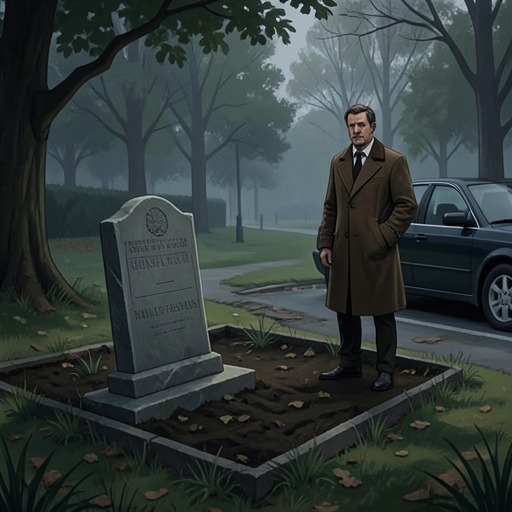
The gravestone bore the name and dates “GEORGE STARK 1975-1988,” followed by “Not a Very Nice Guy.” Its dates suggested a boy who had died in his early teens, while the inscription reduced that imagined life to a dry judgment of character. The stone was not a genuine marker: it had been brought from New York City to the Beaumonts’ summer home in Castle Rock, Maine, as part of the staged publicity surrounding Thad’s disclosure of his pseudonym.
The staged grave and the magazine story
The phrase became the visual centerpiece of a People magazine feature about Thad and his public revelation. The article’s photograph showed Thad holding a spade and Liz a pick beside the grave; cemetery tools filled a wheelbarrow, and bouquets rested on the grave while the inscription remained readable. In the posed image, the couple shook hands over the freshly placed sod and laughed, making the mock burial look like a cheerful performance rather than a solemn interment.
Other photographs in the feature were staged as well, including scenes of the burial and Thad walking alone along a deserted road in Ludlow, apparently gathering ideas. The Beaumonts had long treated People as light entertainment, leafing through it at supper or when no better book was at hand. The discovery that its photographs could be arranged for effect gave the false tombstone an additional frame: the phrase was not only an epitaph, but a deliberately composed image offered to celebrity readers.
The article’s simplified account contrasted Thad, a respected writer whose first novel had been nominated for the National Book Award in 1972, with the much more commercially successful George Stark. Thad had published only one other novel under his own name, while Stark’s identity had been attached to a major bestseller and three successful follow-up novels. The epitaph compressed that public contrast into a neat, entertaining label, even though the actual disclosure had arisen from a more troubling conflict: Thad and his agent had gone public after Frederick Clawson forced the issue, and Thad refused to let Clawson become the story’s focus.
Thad’s unease and Liz’s interpretation
Looking again at the picture, Thad stops attending to the playful expressions he and Liz had posed for and fixes on the inscription. The name, dates, and epitaph trouble him most when considered together. He bursts into laughter, but the laughter does not make the words feel funny; their comic surface and his underlying unease coexist. Thad mutters, “Doesn’t matter,” Thad muttered. “Motherfucker’s dead now.” Even after he says it, the uneasiness remains.
Liz supplies the interpretation that Thad’s public joke conceals. Explaining the photograph to Alan Pangborn, she connects the tombstone’s wording to Thad’s interview answer and insists that he was not truly joking about Stark’s character. She remembers feeling increasingly nervous with each of the four Stark books. When Thad decided to end the pseudonym, she went upstairs and cried with relief. Her account makes the epitaph more than a clever publicity device: it gives public language to a fear she had felt while reading the books and that Thad’s casual phrase had seemed to deflect.
A phrase carried into danger
The phrase’s meaning sharpens against the contrast between the fictional criminal style associated with Stark and the events surrounding his identity. Thad had chosen the name George Stark partly through the example of Donald E. Westlake’s Richard Stark novels, whose protagonist Parker is presented as having almost no interests beyond robbery. Thad compared Parker to a programmed machine and linked that model to Alexis Machine, the central character of the first and last George Stark novels. The phrase “Not a Very Nice Guy” thus labels more than a difficult fictional personality: it sits beside a body of crime fiction shaped around impersonal, persistent criminal action.
The text also places the words near real violence without turning them into an adequate explanation of it. When George Stark attacks Michael Donaldson, he intends to use a straight razor to disable and silence him, but Donaldson’s movement frustrates the planned attack. Elsewhere, Thad imagines the elaborate alibi Alan might have constructed if Thad had an identical twin: one man would remain at a party while another committed the murders attributed to him. That scenario is a hypothesis Thad voices, not a factual account, but it reveals how the ordinary public story of a pseudonym and a staged grave has become entangled with questions of identity and responsibility.
In retrospect, Liz makes the phrase’s inadequacy explicit. She calls Stark a horrible person, not merely someone who falls short of niceness, and says that Clawson’s actions forced them to reveal a story they otherwise might have kept private. The epitaph’s understatement is therefore double-edged: it makes the staged burial funny enough for a magazine photograph while failing to contain what Stark represents to the Beaumonts. What begins as Thad’s quotable dismissal becomes a recurring reminder that naming Stark, burying the name in a public performance, and declaring him dead do not, by themselves, settle the danger attached to him.